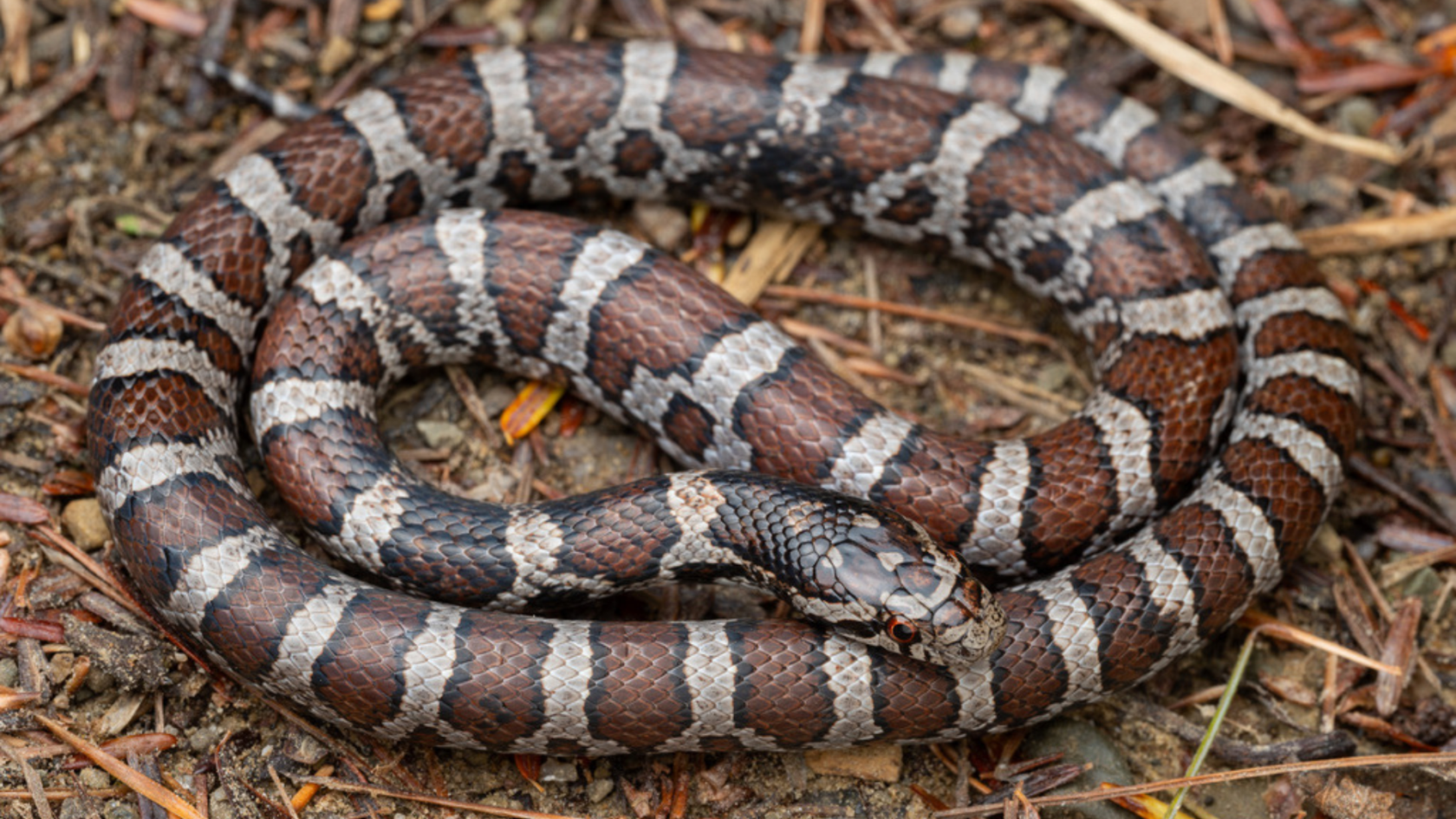
One of my most vivid memories of summer camp at the Norman Bird Sanctuary is walking along a trail with my fellow campers when a counselor suddenly darted into the grass at the edge of the trail and emerged holding an eastern milk snake that seemed at least four feet long. It was the longest snake I had ever seen outside of a zoo, but it wasn’t its length that fascinated me. It was its color pattern: a grayish-brown base broken at regular intervals by irregularly shaped brownish-red blotches lined in black. The eastern milk snake instantly became my favorite snake. And I was really into snakes back then!
This event happened over fifty years ago. I had never seen another milk snake at NBS (or anywhere else, if memory serves me correctly) in those ensuing years. Like so many animals, I figured that it was another species that used to live here, driven away by loss of habitat, climate change, or any host of possibilities. That was until the other day, sunning on the path by the side of the Workshop there was an eastern milk snake! It stayed in that position long enough so I could grab my phone and open the camera before slowly slithering off into the brush. Good thing snakes are deaf because it would have been moving much faster if it had heard my giddy squeals.
In my defense, most of my time on the trails these days is spent looking in trees or scanning the sky for birds. One would figure, though, in over thirty years of leading the Sunday Morning Bird Walk someone would have discovered a milk snake. We’ve seen garter snakes and brown snakes, but no milk snakes.
The snake’s behavior has a lot to do with its elusiveness. Milk snakes are a non-venomous nocturnal predator that subdues its prey by constriction. Thay have a varied diet with small rodents being the most common meal. These snakes spend their days nestling under logs, rocks, discarded boards and have been known to burrow. Their docile nature makes them a popular pet.
I hope it is not another 50 years before I see an eastern milk snake again in the wild. Or maybe I do, which will mean that I am still walking the trails at 115.