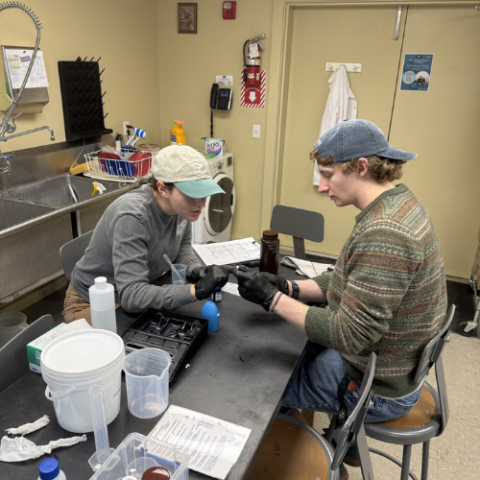
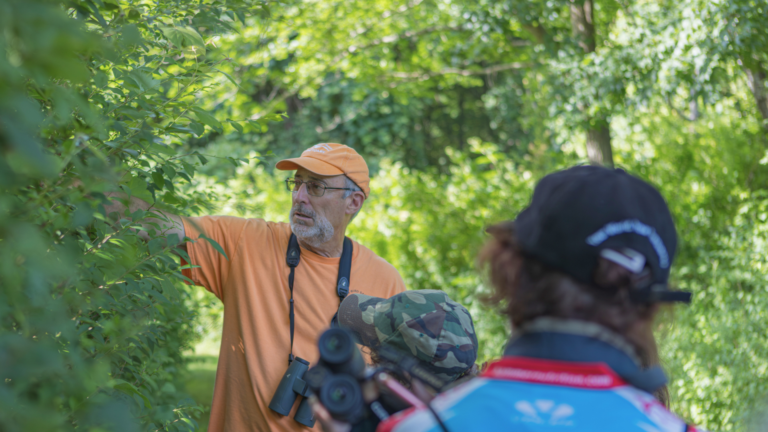
Originally published in Newport This Week, the following letter to the editor was written by Science Communication Intern Kathleen “Kit” Guinivan. Her piece explores the impacts of light pollution and was inspired by a lecture hosted at NBS.
Last month, I attended a lecture by Dr. Avalon Owens from Harvard’s Rowland Institute at the Norman Bird Sanctuary about the impact of light pollution on pollinators. As a student of environmental studies at Salve Regina University, I am concerned about the lack of awareness around this issue and would like to share some of the information that I learned.
Light is foundational to all life on earth. It is integral to our evolutionary history, spatial awareness, and perception of time. Humans operate around the movement of the sun, and when the sun has set, we use artificial light to navigate our way in the dark.
Unfortunately, this creates light pollution, which degrades the quality of habitats for nocturnal insect pollinators, who account for one-third of all pollinators. Artificial light at night is dangerous for insects because it disrupts their internal navigation systems and interferes with their ability to eat, mate, and pollinate and leaves them vulnerable to predators and exhaustion. Flowers in areas with artificial light have received 62 percent fewer visits from nocturnal pollinators than those in dark areas, according to researchers.
The “Insect Apocalypse” isn’t just buzzword, it’s a crisis unfolding on Aquidneck Island. As habitat loss and light pollution drive down insect populations, our local food web crumbles. North America has lost nearly three billion birds since 1970, many of which are insect-eaters that rely on healthy moth and beetle populations. Wildlife refuges such as the Norman Bird Sanctuary know that we must nurture and protect insect habitats to support healthy bird populations. We can bring back the dark for our pollinators at no cost to human safety.
Join us in taking these simple, effective steps recommended by the Xerces Society and Dr. Owens to reduce light pollution in our community:
- Keep it essential: Turn off decorative lighting to help our local pollinators navigate safely.
- Use motion sensors: Motion sensors provide safety without constant disruption.
- Point it down: Shield your fixtures so they illuminate your path, not the sky.
- Go red or amber: Swap bright white bulbs for warmer red or amber tones. Studies conducted by Dr. Owens show that insects are the least impacted by these colors.
- Reduce brightness: Dimming your outdoor lights is a simple way to make a big difference for Aquidneck Island’s wildlife.
For more information, check out Xerces Society Lighting Guidelines.
Kathleen Guinivan
Salve Regina University ‘27