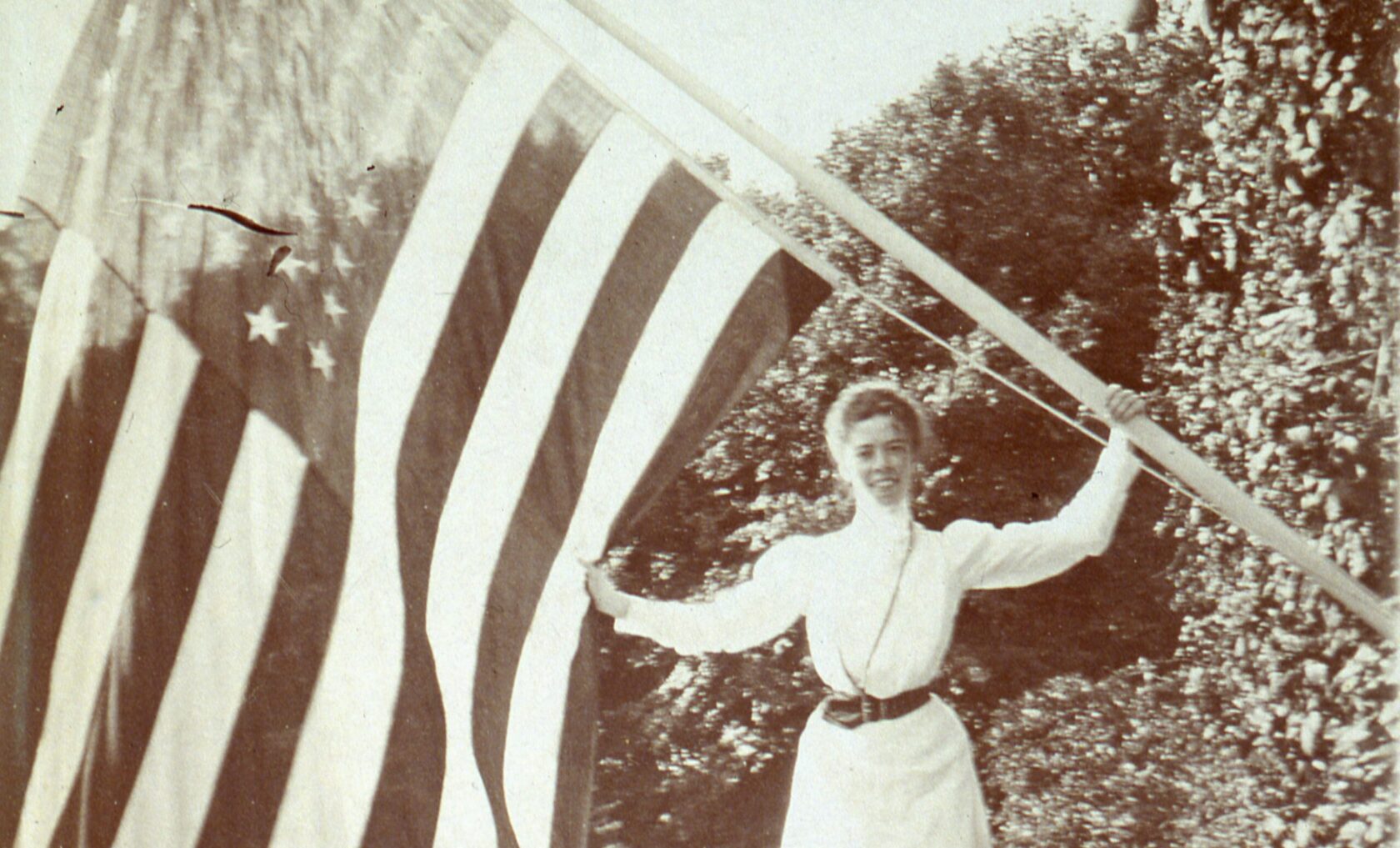
Norman Bird Sanctuary founder, Mabel Norman Cerio, poses with the American flag. Photo from the Collection of the Newport Historical Society.
As the United States celebrates its 250th anniversary, communities across the country are reflecting on the people and places that shaped the American story. In Aquidneck Island’s Paradise Valley, Norman Bird Sanctuary offers a deep connection to that history. Long before it became a wildlife sanctuary, this landscape was part of a centuries-old farming community whose roots reach back to the earliest colonial settlement of Rhode Island. The picturesque south coast of Middletown has been known as “Paradise” since the eighteenth century.
Anglo settlement of the area dates to the seventeenth century, when a group of four colonists came into possession of a broad swath of oceanfront farmland in what was then part of Newport. Among them was Edward Smith (1629–ca. 1675), an Anabaptist who emigrated from England around 1642. Like many early Rhode Islanders, Smith sought freedom of conscience after encountering religious persecution in Plymouth and the Massachusetts Bay Colony. Together with Obadiah Holmes, James Mann, and William Davol, he acquired land in what is now Middletown’s Paradise Valley, helping establish a community founded on principles of religious liberty that would later become central to the American identity.
The story of what is now Norman Bird Sanctuary begins to emerge clearly in colonial records in 1714, when Edward Smith’s grandson purchased a coastal property known as “Sachuest Farm.” At the heart of the property stands the historic farmhouse, likely built by Isaac Smith (1698–1769) around 1750. Probate records from 1755 reference the property’s “land and buildings,” confirming the existence of the farmhouse before the Revolutionary era. From this farmhouse, the Smith family managed what became a roughly 200-acre “saltwater farm,” where sheep grazed on the coastal ridges, salt marsh hay was harvested from nearby wetlands, and mixed crops were cultivated on fields overlooking Second and Third Beach.
When the Declaration of Independence was adopted in July 1776, the Smith farm was already more than a quarter-century old. As Rhode Island played a critical role in the struggle for independence, the farm and its occupants lived through the uncertainty and challenges of the Revolutionary War. The land that visitors enjoy today at Norman Bird Sanctuary was part of the lived experience of the generation that witnessed the birth of the United States. The Revolution also marked a turning point for the property. In March 1782, Philip Smith petitioned the Rhode Island General Assembly for permission to sell the farm to settle debts incurred by his brother Isaac. At a public auction later that month, Benjamin Gardiner (1750–1819) of North Kingstown submitted the winning bid of 7,780 Spanish milled dollars, bringing nearly seventy years of Smith family ownership to an end.
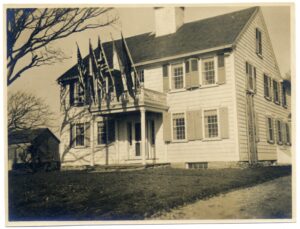 Gardiner’s purchase ushered in a new chapter in the farm’s history. He renovated the farmhouse, adding a kitchen wing to the northeast, and shifted agricultural production from a primary emphasis on sheep grazing to dairy farming and the cultivation of grain, barley, and Indian corn. The Gardiner family occupied the property until 1819, leaving a lasting imprint on the landscape. Benjamin Gardiner himself was laid to rest in the family burial ground, one of two historic grave sites located on the Norman Bird Sanctuary campus today.
The landscape itself continues to tell the story of generations of labor and stewardship. A remarkable network of fieldstone walls—stretching nearly five miles throughout the 300-acre property—defines former fields, orchards, gardens, sheep pens, and property boundaries. Built from stones cleared from the land by early farmers, these walls stand as enduring monuments to the hard work of colonial and early American agricultural life. They connect present-day visitors to the people who transformed a rocky coastal landscape into a productive farm and helped shape the character of Rhode Island’s rural communities.
As America commemorates 250 years of independence, Norman Bird Sanctuary offers more than beautiful scenery and wildlife habitat. It preserves a living landscape that reflects the values and experiences of the nation’s earliest generations—religious freedom, perseverance, community, and stewardship of the land. From the arrival of Edward Smith in search of liberty, to the colonial farmstead that witnessed the Revolutionary era, to the preserved landscape enjoyed by thousands today, Norman Bird Sanctuary embodies a uniquely American story.