It has been almost over two weeks since 13 inches of snow fell on the Norman Bird Sanctuary and I’m starting to get cabin, or more appropriately, office fever. The heavy snowfall and ensuing deep freeze have curtailed pretty much all outside activities except for filling the bird feeders and shoveling the occasional windblown drift. I want to be removing privet, fixing the Nelson Pond Trail boardwalk, OUTSIDE!
Sensing my own breaking point, I brought my snowshoes into work today. I grabbed them and told my officemate, NBS Science Coordinator Sara Poirier, that I’m going to do a trail check along the Woodland and Woodcock Trails.
 Today is one of those glorious sunny winter days where the lack of wind makes it feel fifteen degrees warmer than it is. I zip up my vest and get started. The thin crust of icy snow over nice powder gives way with every crunching footstep. I will not be sneaking up on anything during this walk. Previous hikers and cross-country skiers have made a path along the Woodcock Trail, so walking is easier but no less quiet. Taking a right onto the Woodland Trail, I walk past the site where the Conservation Crew has cleared a dense growth of privet and freed a series of cranberry viburnum trees whose existence was unknown before the project. Through December the bright red berries of this plant were still on the trees, a phenomenon that I found surprising since berries provide the sugars and fats that generate the energy for songbirds to survive in the winter. My concern about their palatability was somewhat unfounded because under one viburnum the snow looked like chocolate chip peppermint stick ice cream. Clearly turkeys have been feeding here, but how can that be? There is no way these lithe trees could support a turkey. My guess is they were feeding on the berries dropped by robins.
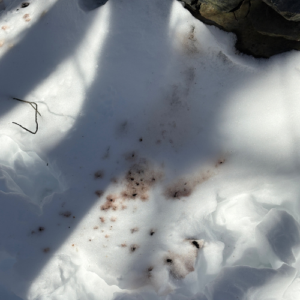
The Woodland Trail continues through a break in a stonewall and parallels the Harvest Fair Field. Here the snow is stained with purple drops. There is a prolific patch of privet along this section of the trail. Privet is the Sanctuary’s most widespread and problematic invasive species. Its shallow root system blocks native plants from coming up through the soil, and prevents water from seeping in, impacting the forest’s soil health. In the more than two acres of privet removed by the Conservation Crew, only two bird nests were found, an indicator of the plant’s unsuitability as habitat. Deer won’t eat its shoots. Its purple berries are the food of last resort for birds, eaten only when all other berries have been picked clean.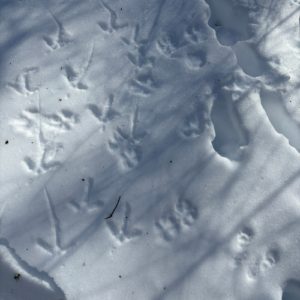
The trail now leaves the grove of privet and skirts the Polaris Field. The only sign of human travel is a track of cross-country skis that have mostly been filled in by blowing snow. Here human footprints have been replaced by many turkey tracks. I have been wondering where they have been. Prior to the storm, the turkeys were regular visitors to the feeders near the Welcome Center, often feeding out of the lowest ports in the feeders. I haven’t seen them since the storm. I notice that coyote tracks are as numerous as the turkey tracks once the trail heads into the woods. There is a pile of snow on either side of the start of the Woodland Trail boardwalk. The one on the right is a pristine white while the left pile has been heavily yellowed. I have discovered a coyote message board. I know that coyotes tend to travel in packs during the winter. Is the boardwalk a territorial intersection between two packs? As I ponder this, a lone coyote howls from the woods.
The coyote tracks are the only imprints in the snow beyond the boardwalk besides the cross-country skiers until the Woodland rejoins the Woodcock and I make my way back to the office. There the turkey tracks resume. Where are they hiding? What do they eat when snow blankets the ground? Not ticks, unfortunately.
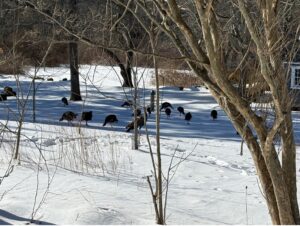 Heading up the hill by the Good Gardens I have my answer. The crusty snow that made every step echo through the wood is now thick enough to support a flock of 16 turkeys as they venture from the woods back to the bird feeders! The privet throughout the woods may still have a reprieve but at least somethings are returning to their pre-storm level of activity.